
You finally got the MRI. You waited weeks for the appointment, laid still in that claustrophobic tube for 45 minutes, and then waited a few more days for the results. And when they came back, your doctor told you everything looks normal.
So why do you still hurt?
Or maybe the opposite happened. Your MRI came back with a laundry list of findings. Disc bulge. Degenerative changes. Partial thickness tear. And now you are convinced your body is falling apart and you will never train the way you used to.
Both of these situations happen constantly. And in both cases, the MRI is only giving you part of the picture.
Imaging Shows Structure, Not Function
An MRI is incredibly good at one thing: showing what your tissues look like. It can identify tears, inflammation, bony changes, and structural abnormalities with impressive detail.
What it cannot show is how your body moves. It cannot tell you which muscles are underloaded, where your movement compensations are, or why a specific pattern is breaking down under fatigue. It is a snapshot of anatomy, not a map of your problem.
Pain is far more complex than structure alone. Two people can have identical MRI findings and one of them is training without any issues while the other can barely get through a workout. This is not rare. This is incredibly common and there is decades of research to back it up.
The Research Is Pretty Clear on This
Studies consistently show that it is very common to find “significant image findings” in people who are asymptomatic. Meaning they are in no pain whatsoever, but the image shows something is structurally damaged.
Some examples of this: Rotator cuff tears show up in roughly 50 percent of people over 60 who have no shoulder pain at all. Lumbar disc bulges are found in a significant portion of pain-free adults across all age groups. Meniscus degeneration, labral fraying, and cartilage changes are routinely found on MRIs of people who are training hard and feeling completely fine.
These findings are often a normal part of aging and loading. They are not automatically the source of your pain. And treating the image instead of the person is one of the most common reasons people end up in a cycle of procedures and interventions that never actually fix anything.
When a Normal MRI Feels Like a Dead End
If your imaging came back clean and you are still hurting, the most important thing to understand is this: normal findings do not mean your pain is not real. It means the problem is not structural.
That is actually useful information. It usually means the driver of your pain is neuromuscular, meaning it lives in how your body is moving, loading, and compensating rather than in a torn or damaged tissue. That is something a good movement assessment can find when imaging cannot.
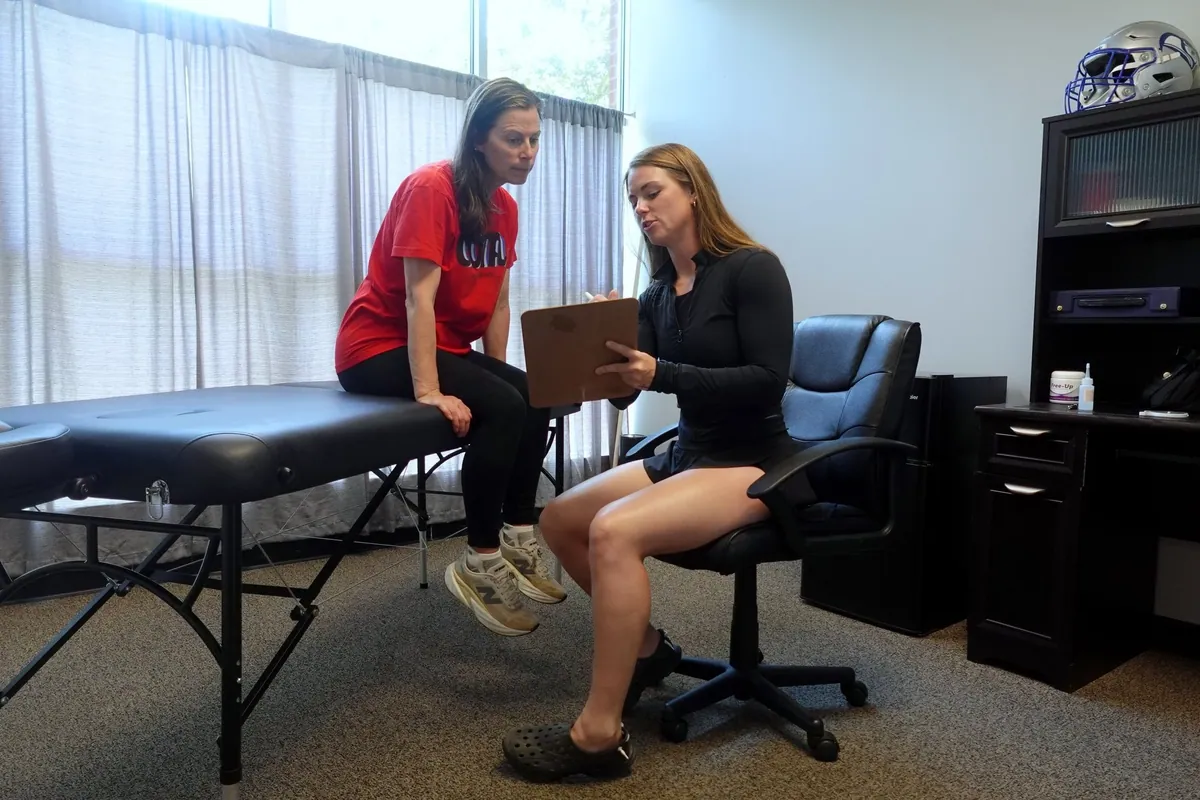
This is exactly why the evaluation I do at Monarch goes far beyond looking at your report. I want to see you move. I want to watch you do the thing that hurts, test how your strength holds up under load, and identify where the breakdown is actually happening. That tells me far more than a radiology report ever could.
When an Abnormal MRI Feels Like a Catastrophe
On the flip side, getting a report full of findings can feel terrifying. Words like degenerative, tear, and abnormality carry a lot of weight even when the clinical significance is low.
Here is what I want you to remember. A finding on an MRI is not a sentence. It is information. And in many cases, athletes with significant imaging findings return to full training and competition with the right rehabilitation approach.
A partial rotator cuff tear does not automatically mean surgery. A disc bulge does not automatically mean you can never deadlift again. Cartilage changes in your knee do not automatically mean your running days are over. Context matters enormously and that context comes from a thorough clinical evaluation, not from the image alone.
What Actually Matters
What I care about when you come into Monarch is to learn your full history, understand your training, know your goals, and then watch you move.
The MRI might be one piece of that puzzle. Sometimes it is a useful piece. But it is never the whole picture and it should never be the only thing driving your treatment plan.
If you have been told your imaging is normal but you are still struggling, or if you have a report full of findings and you are not sure what any of it actually means for your training, that is exactly the kind of conversation I have with athletes every day.
You deserve a plan built around what your body is actually doing, not just what a scan says it looks like.
Schedule your initial evaluation today and let’s start building that plan.
-Dr. Kiley