Little League Shoulder and Elbow: What Parents Should Know Before the Season Starts
There's a specific kind of fear that hits me when a young baseball or softball player walks in, usually somewhere between 9 and 14 years old, with shoulder or elbow pain that seems to have come out of nowhere.
Then I ask a few questions, and it's almost never actually random.
Their pitch volume jumped significantly from last season.
They're the hardest thrower on the team, the one every coach wants on the mound in a close game.
They're playing for two or three teams at once with barely any real break in between.
None of that is a coincidence. It's exactly the profile of an arm that's been asked to do too much, too fast, without enough recovery built in.
As a Doctor of Physical Therapy who played softball through college, I've seen this from both sides of it, as the athlete and now as the person treating these injuries. So let's talk about what's actually happening in a young throwing arm, and why catching it early matters more than people think.
What Little League Shoulder and Elbow Actually Are
These are overuse injuries specific to growing athletes, and they're different from what we see in adult throwers.
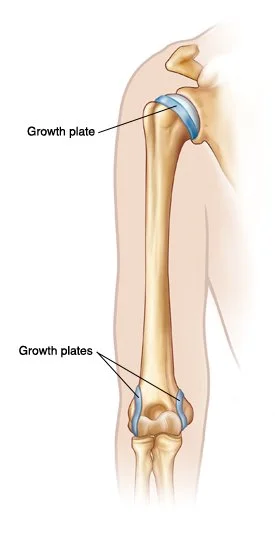
Little League shoulder (the clinical term is proximal humeral epiphysiolysis) is a stress injury to the growth plate at the top of the upper arm bone, right where it meets the shoulder. Little League elbow (medial epicondyle apophysitis) is a stress injury to the growth plate on the inside of the elbow. Both come from the same root cause: repetitive throwing stress on bone that hasn't finished developing yet.
This is the part most parents don't realize. In an adult thrower, that same repetitive stress usually shows up as a UCL sprain or a labrum issue, because the growth plates have already closed and the soft tissue takes the load instead. In a kid, the growth plate is actually the weakest link in the chain. It gives before the ligament does.
Why This Shows Up in Young Throwers Specifically
It comes down to timing. Open growth plates are softer than the surrounding tendon and ligament tissue around them, which means repetitive throwing stress finds that weak point first. Add in a kid who's pitching for one team, catching for another, and playing travel ball nearly year round with no real offseason, and you've got a setup for exactly this kind of injury.
Every young thrower has this vulnerability, it just shows up faster in the ones throwing the most without enough recovery built in.
Signs Parents Should Actually Watch For
"My arm hurts" is the obvious one, but it's usually not the first sign. Here's what tends to show up earlier:
Pain that gets worse as the game or practice goes on, then eases up with rest, only to come right back the next time they throw.
A drop in velocity or accuracy that doesn't have an obvious mechanical explanation.
Pain that's specifically located at the point of the shoulder or the inside of the elbow, rather than general soreness through the whole arm.
And pain that's still there the next day, not just immediately after pitching.
If any of that sounds familiar, it's worth getting evaluated before the next outing, not after it.
Why "Just Rest It" Usually Isn't Enough
Resting until the pain goes away, then jumping straight back into the same pitch count and the same throwing schedule that caused the problem, is probably the most common mistake I see. The pain goes away because the tissue calmed down, not because anything that caused it actually changed. So it comes right back.
A proper return needs to actually address what led there in the first place: throwing mechanics, total workload across all the teams a kid is playing for, and a real, gradual buildup back into pitching instead of going straight from rested to game ready.
How Many Pitches Is Too Many
This is where Pitch Smart, the joint program from MLB and USA Baseball, is genuinely useful. It sets age based daily pitch limits and required rest days, and it exists specifically because research showed overuse, not mechanics or pitch type, is the biggest driver of these injuries. As a rough idea, a 9 to 10 year old has a daily max of 75 pitches, while throwing more than 65 in a day requires several days of rest before pitching again. The exact numbers shift by age, but the principle stays the same: pitch counts and rest days matter just as much as mechanics, and tracking them across every team a kid plays for, not just one, is what actually protects their arm.
A Few Quick Questions
Is it normal for a young pitcher's arm to hurt a little after every game?
Mild, general soreness that fades within a day is common. Pain that's sharp, localized, or still there the next time they throw is not something to wait out.
Does this only happen to pitchers?
Pitchers see it most because of throwing volume, but catchers and other position players who throw a lot are at risk too, especially kids who play multiple positions or multiple teams.
Can a kid keep playing through it?
Generally no. Continuing to throw through this kind of pain risks turning a stress injury into something more serious, including a growth plate fracture in more severe cases.
What now?
If your young athlete has been dealing with shoulder or elbow pain that doesn't add up to normal soreness, this is not something to mess around with. Schedule your initial evaluation today and let’s figure out exactly what is going on, before it’s too late.