

Most athletes who sign up for their first HYROX have the same thought process. They can run. They train in the gym. This event combines both of those things. They are going to be fine.
Then race day happens.
HYROX is not just a running race with some gym work sprinkled in. It is a sustained test of what your body can do when it is already tired, and then tired again, and then tired one more time after that. The running does not give you a break from the stations. The stations do not give you a break from the running. That is the whole point, and it is also exactly why the injury patterns in HYROX athletes look the way they do.
As a sports physical therapist and CSCS who has not only treated HYROX athletes but competed in the event myself, here is what breaks down most often and how to make sure it is not you.

Knee Pain
This one shows up constantly, and it makes sense when you think about what HYROX actually asks your knees to do.
You are running several kilometers. Then you are doing weighted lunges with a sandbag. Then more running. Then wall balls. The knee is absorbing load in a fatigued state, repeatedly, for the entire race.
The most common culprits are patellofemoral pain and patellar tendinopathy. Both are essentially overuse injuries driven by the same underlying problem: too much load, not enough capacity, and usually some hip weakness quietly making everything worse.
When the hips are not doing their job during your lunges or your running stride, the knee picks up the slack. Every rep. Every step. Until it starts sending you strongly worded messages.
The fix is not to stop doing lunges. It is to build the hip and quad capacity that lets your knee handle the demand without hitting its limit.
Lower Back Pain
The sled push and sled pull are incredible for building strength. They are also incredibly good at exposing any weakness in your ability to maintain a stable spine under load.
When the core cannot maintain position during a heavy sled push, the lumbar spine compensates. When your hip flexors are tight and your posterior chain is underprepared, the lower back ends up doing work it should not be doing.
Add fatigue from running and the fact that most people train the sled stations nowhere near race intensity, and you have a recipe for a lower back that is not ready for what race day actually demands.
The back is usually not the root cause. It is the thing that absorbs the consequences of problems elsewhere. We look at hip mobility, core stability, and movement patterns under fatigue. That is where the answer usually lives.
Shoulder and Rotator Cuff Issues
The ski erg and wall balls are the main offenders here.
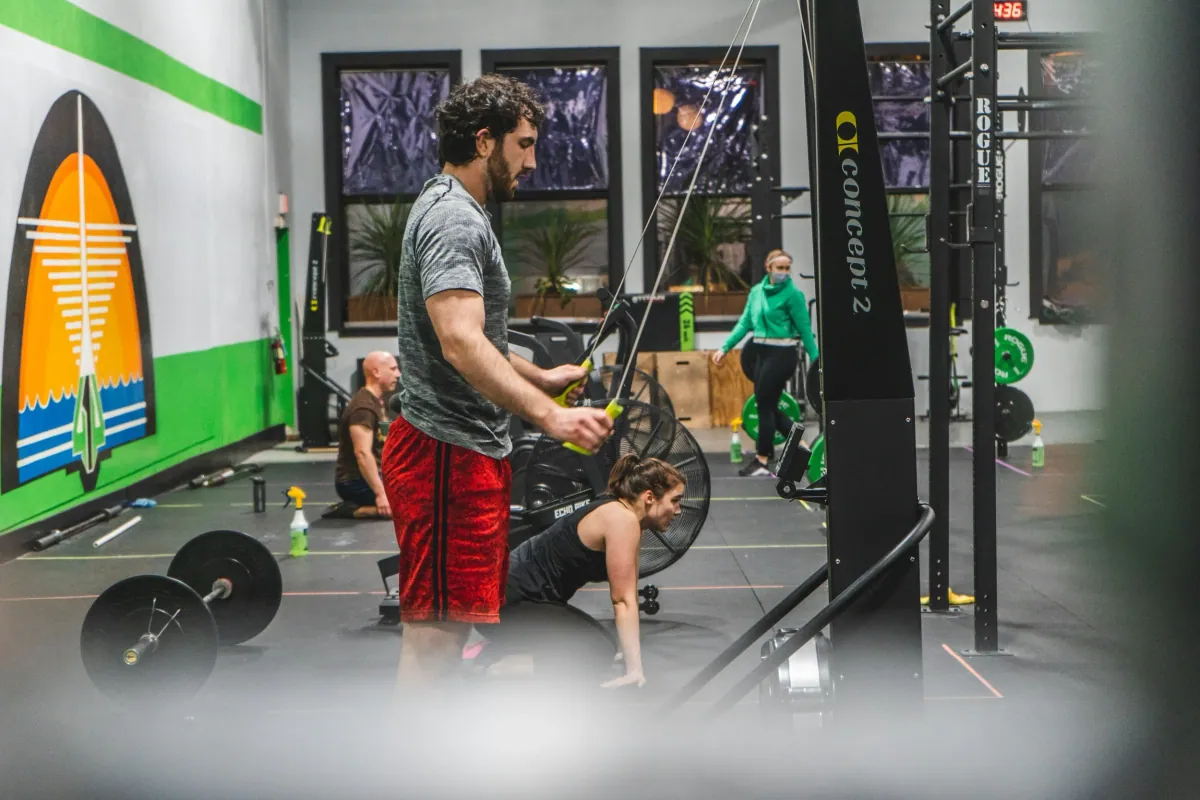
The ski erg puts your shoulder through a powerful pulling pattern under fatigue. Wall balls put it into repeated overhead loading. Neither is a problem on its own. Combined with the cumulative fatigue of everything else in the race, and with a shoulder that lacks the rotator cuff strength and scapular stability to maintain position rep after rep, it becomes a problem fast.
If your shoulders feel fine during training but start to break down toward the end of a race or a long training block, that is a capacity issue. Your shoulder can handle the movement when it is fresh. It cannot handle the movement when it is tired. Building true rotator cuff endurance and scapular stability is what closes that gap.
Achilles and Calf Strain
Running several kilometers in a fatigued state after loaded stations puts enormous demand on the calf and Achilles complex. This is especially true for athletes who are not running-specific in their training and whose calf tissue has not been prepared for the volume HYROX demands.
The Achilles does not like surprises. Ramping up running volume too quickly in the weeks before a race is one of the most common ways this injury shows up. The tissue simply has not had time to adapt to the load being placed on it.
Progressive loading and an honest look at your weekly running volume are the two biggest factors in keeping the Achilles healthy through HYROX prep.
How to Actually Prevent HYROX Injuries
Understand what HYROX actually is. At its core, HYROX is a fatigued running event with obstacles in between. The stations are hard. But the running is what makes them hard. You are not doing wall balls with fresh legs. You are doing wall balls after running a kilometer with legs that already have several kilometers on them. That context changes everything about how you need to prepare.
A lot of functional fitness athletes significantly underestimate the running demand. Eight kilometers is not a warmup. It is the thread that connects every single station and the reason your technique breaks down in the back half of the race. If you are not running consistently in training, your body is simply not prepared for what that cumulative load does to your movement quality when it matters most.
Do fatigued running workouts intentionally. Run a kilometer, go straight into a loaded station, run again. Pay attention to where your form starts to break down, where your knees start to cave, where your lower back starts to round, where your shoulders stop holding position. That is your body telling you exactly what needs work. Those breakdowns under fatigue are not random. They are your weakest links showing up when your body no longer has the energy to hide them. Train in that state regularly so race day does not expose you for the first time.
Build single leg strength. Lunges, step-ups, single leg press. HYROX is a unilateral sport disguised as a bilateral one. Asymmetries that are invisible during bilateral training become very visible when your legs are tired and you are trying to lunge a sandbag for 100 meters.
Strength train year round. Not just in race prep blocks. Athletes who maintain a consistent strength training base have more tissue capacity to absorb the demands of a HYROX event. It really is that simple.
Ready to Train Smarter for HYROX?
Whether you are dealing with a nagging injury from your last race or you want to make sure you build into your next one without breaking down, we can help.
At Monarch Physical Therapy, every session is one full hour, one-on-one, with a Doctor of Physical Therapy and Certified Strength and Conditioning Specialist. We work with athletes in Charlotte, Ballantyne, and Fort Mill who want to perform at a high level and stay healthy doing it.
-Dr. Kiley