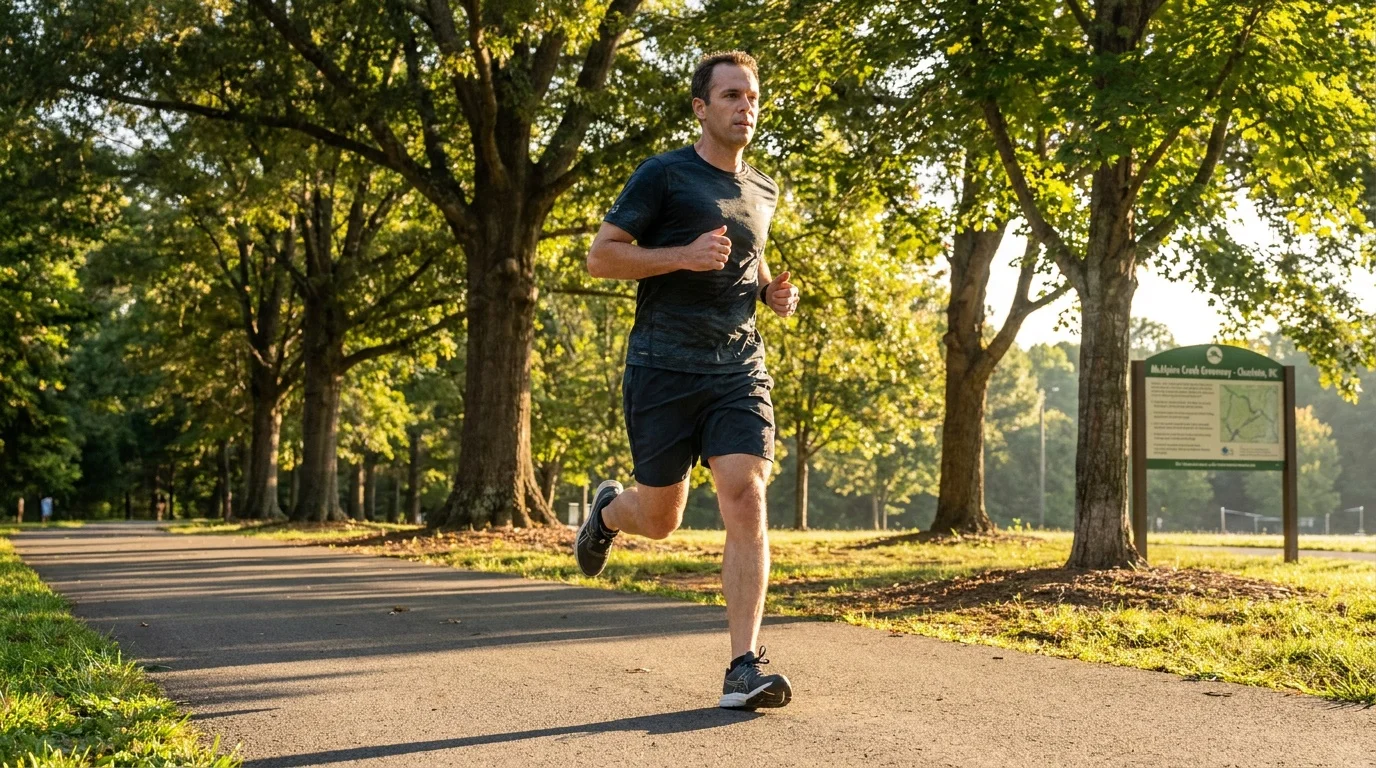

You are a mile into your run and it starts. A dull ache along the inside of your shin. It eases once you warm up, so you finish the run. Then the next morning, walking down the stairs, it is right back.
Maybe you took a week off and it felt fine. Maybe you bought new shoes, iced it every night, and wore compression sleeves. And then the first week you were back to full mileage, it came right back.
That is how most runners end up in my office.
Rest is a pause, not a treatment. Let me break down what is actually going on, how to tell shin splints from a stress fracture, and what actually fixes them.
What Are Shin Splints, Actually?
The clinical name for shin splints is medial tibial stress syndrome, or MTSS. It is pain along the inside edge of the lower two thirds of your shin bone (the tibia), where the muscles of your calf attach to the bone.
In plain words, your shin is getting more load than it can recover from between runs. Bone adapts to load, the same way muscle and tendon do. It just adapts slowly. Shin splints are what it feels like when your training gets ahead of that adaptation.
They are common. Prospective studies of runners put the rate somewhere between 14 and 20 percent, and the number is higher in newer runners.
Shin Splints or a Stress Fracture?
Shin splints and stress fractures sit on the same spectrum. Both are bone stress injuries. Shin splints are the early end. A stress fracture is what happens when you keep loading a bone that is already overloaded.
Signs that point more toward a stress fracture:
- Pain in one small spot you can cover with a fingertip, instead of a longer strip of tenderness
- Pain at rest or at night
- Pain that gets worse as you run instead of easing up after you warm up
- A limp, or pain when you hop on that leg
When a runner comes in with shin pain, one of the first things I check is whether they can hop on that leg. If hopping hurts, we stop there and get imaging before we do anything else.
And a normal X-ray does not clear you. Stress fractures often do not show up on an X-ray in the first few weeks. An MRI is the test that shows them. I talk a lot about how MRI findings do not tell the whole story, but this is one case where imaging is exactly the right call.
If you have sharp pain in one spot on the bone, pain at rest, numbness, or a calf that is swollen and tight, see a doctor before you run again.
Why Shin Splints Happen
Shin splints are almost never just a shin problem. The shin is the one sending the complaint emails. The root cause is usually somewhere else.
Too much, too soon. A jump in mileage, a new race block, speed work, or hills all add load faster than bone can adapt. Fewer years of running is one of the known risk factors, along with a past history of shin splints.
Calves that cannot handle the load. This is the big one. Your calf muscles, especially the soleus, help absorb the bending load on your tibia every time you land. One study compared runners with shin splints to matched runners without them. The runners with shin splints had a thinner soleus, weaker muscles all around the lower leg, and less calf endurance. When the muscle cannot take the load, the bone takes more of it.
How you land. Long strides and a slow cadence, meaning the number of steps you take per minute, put more load through your shins with every step. Foot and hip mechanics, like an arch that collapses as you land or extra hip rotation, also show up in the research on runners with shin splints.
Not eating enough for your training. If you are not taking in enough energy to match what you are burning, your bones pay for it. Low energy availability raises the risk of bone stress injuries, and women are at higher risk of shin splints in general.
What Won't Fix It
Rest alone. The pain settles, but your calves and bones are no more prepared than they were before. So it comes back the first week you return.
New shoes alone. Shoes can change how load is spread across your foot and leg. They do not build capacity.
Ice and compression sleeves. Fine for comfort. But a review of the treatment research found no proof that sleeves or braces change the outcome.
Pushing through it. This is how shin splints turn into a stress fracture. Please do not do this.
I want to be honest with you here, because there is a lot of overclaiming in this space. The research on treating shin splints is thin, and no single treatment has strong proof behind it. Some studies point to shockwave therapy as the most promising passive option. I do not offer it, and even when it helps with pain, it does not build the capacity your leg was missing. That is why I treat the root cause and not just the shin.
What Actually Works
When a runner comes to me with shin splints, here is what I am looking at.
Where your capacity is. I test single leg heel raises to failure and measure calf strength with a handheld dynamometer, comparing one side to the other. I look at hip control, how you hop, and how you actually run.
Load, not total rest. Most runners do not need to stop everything. We find a level of running that does not flare your shin, and we keep you training around it with cross training.
Rebuild the calf. Progressive loading of the calf and soleus is the center of the plan. That means bent knee and straight knee heel raises, then heavier and single leg work, plus strength for the muscles on the front of the shin and the foot. This is the same calf loading I talk about in why runners need strength training.
Small changes to how you run. Raising your cadence by 5 to 10 percent lowers the load through your tibia without making running feel harder.
A criteria based return. You go back to full training when hopping is pain free and your calf endurance is close to the other side, then you build back with a structured walk run progression. Not because a certain number of weeks went by.
Pain going away is the floor, not the ceiling.
How Long Do Shin Splints Take to Heal?
It depends on how long you have been running through it and where you are on that bone stress spectrum. A mild case caught early usually settles faster than one you have trained through for months. A stress fracture is a longer road than shin splints.
I will not give you a number before I have assessed you. After your first evaluation, I will tell you where you are and what the plan looks like.
The Bottom Line
Shin splints are a capacity problem. Rest calms them down. Load fixes them.
If you are a runner in Charlotte, Steele Creek, Ballantyne, or Fort Mill and your shins flare up every time you build your mileage, this is exactly what I treat. Every session is a full hour, one-on-one with me, a Doctor of Physical Therapy and Certified Strength and Conditioning Specialist who works with runners to find the root cause and get you back to your miles.
Schedule your initial evaluation today and let's figure out exactly what is going on. Not ready to book yet? I offer a free 15-minute phone consultation to go over your questions, concerns, and goals.
Thanks for reading!
-Dr. Kiley
This article is for education only and is not medical advice. If you have sharp pain in one spot on the bone, pain at rest, or pain that stops you from running, get evaluated before you keep training.