
One of the most common things I hear from athletes who walk through my door with low back pain goes something like this: "My doctor told me I have degenerative disc disease. I am not sure if I should still be ____ (insert: deadlift, squat, run, anything that brings you joy)
They say it the way someone would say they just got a serious diagnosis. And honestly, I get it. The name alone sounds awful. Degenerative. Disease. Those are not words anyone wants attached to their spine.
But here is what I tell every single one of those athletes: degenerative disc disease is one of the most misunderstood and frankly most misrepresented findings in all of musculoskeletal medicine. And the way it gets communicated to patients, especially active ones, does a tremendous amount of unnecessary damage.
Let me break down what is actually going on.
What Degenerative Disc Disease Actually Is
First, it is worth pointing out that degenerative disc disease is not really a disease at all. It is a term used to describe age-related changes in the intervertebral discs of the spine. As we get older, our discs naturally lose some hydration, become thinner, and show structural changes on imaging. This is a normal biological process, not a pathological one.
Think about it this way. As we age, our outsides change. Our skin develops wrinkles, our hair goes grey, our faces look different at 45 than they did at 25. Nobody calls that a disease. We just call it getting older.
So why would we expect the inside of our bodies to be any different? Our spines age just like everything else\.
The problem is that when those findings show up on an MRI report, they get labeled, handed to a patient, and interpreted as the cause of their pain. And that is where things can go wrong.
How Common Is This Actually
Here is the part that should reframe everything. Research consistently shows that degenerative disc changes are extraordinarily common in people who have absolutely no pain at all.
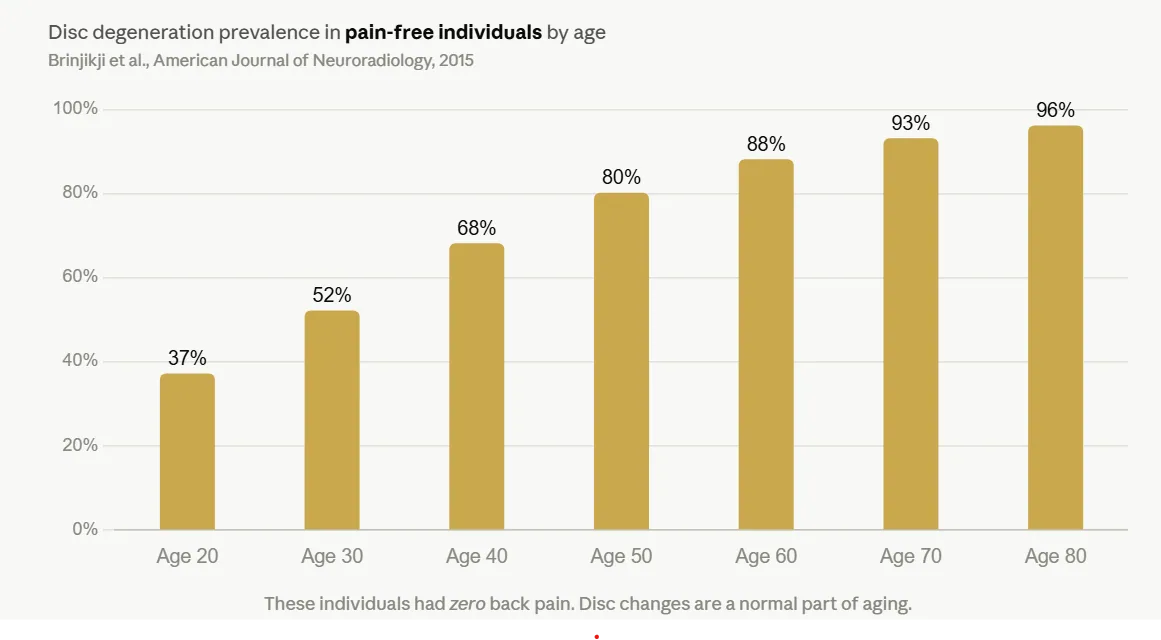
A landmark systematic review published in the American Journal of Neuroradiology looked at MRI findings in asymptomatic individuals across multiple age groups. The findings were striking. Disc degeneration was present in roughly 37 percent of asymptomatic people in their 20s. By age 50 that number climbs to around 80 percent. By age 60 it is close to 90 percent. These are people with zero back pain, living their lives, training, working, doing everything normally.
Let that sink in. Nearly 80 percent of 50 year olds have disc degeneration on MRI and feel completely fine.
So when an athlete in their late 30s or 40s gets an MRI for back pain, sees degenerative disc disease on the report, and is told that is the reason for their pain, the reality is that finding might have been there for years before the pain ever started. The disc changes are not necessarily the driver. They may just be what the camera caught while looking for something else.
Why the Diagnosis Causes So Much Harm
The label itself is part of the problem. When someone is told they have a degenerating spine, they change how they move, how they train, and how they think about their body. They start avoiding load. They stop deadlifting. They quit running. They modify every workout out of fear that they are making something worse.
And in many cases, that avoidance is exactly what allows the pain to persist and worsen. Movement and progressive loading are two of the most well supported treatments for low back pain in the research.
I have seen athletes come in who had been modifying their training for months or even years based on a DDD diagnosis, convinced their spine could not handle load. And in almost every case, a thorough movement assessment revealed something very different from what the imaging suggested. Strength deficits, movement compensations, hip mobility restrictions, poor load distribution patterns. Fixable things. Things that had nothing to do with the degree of disc degeneration on their MRI.
What the Research Actually Says About Training With DDD
The evidence on this is pretty clear. Spinal loading through resistance training, done progressively and with good mechanics, does not accelerate disc degeneration. In fact, exercise is consistently recommended as a primary treatment for chronic low back pain, including pain associated with degenerative disc changes.
The spine is designed to be loaded. It is one of the most robust structures in the human body. Discs respond to load the same way muscles do, they adapt. Controlled, progressive training builds tolerance and resilience. Avoiding load does the opposite.
This does not mean you should ignore pain or push through a flare blindly. It means that a diagnosis of DDD alone is not a reason to stop training. It is a reason to train smarter, with guidance from someone who understands how to build load progressively around what your body actually needs.
What I Actually Look For
When an athlete comes in carrying a DDD diagnosis, I am not leading with the MRI. I am looking at how they move.
Where does the breakdown happen under load? Is there a hip mobility restriction driving excessive lumbar extension on a deadlift? Is there a core stability deficit that shows up under fatigue? Is the pain truly discogenic or is it coming from the facet joints, the SI joint, the surrounding musculature? Imaging tells me what things look like. A thorough movement assessment tells me what is actually happening.
In most cases the treatment plan involves progressive loading, targeted strength work, movement pattern correction, and education. That last one matters more than people expect. Understanding what DDD actually is and what it actually means for your training removes the fear, and removing the fear is often the first step toward getting better.

The Bottom Line
Degenerative disc disease is a normal part of aging. It shows up on the MRIs of millions of active, pain-free people every year. It does not mean your spine is broken. It does not mean your training days are numbered. And it is not a life sentence.
What it means is that your spine looks like the spine of someone your age. But often times, that is not your primary pain driver.
If you have been handed this diagnosis and are not sure what it actually means for your training, that is exactly the kind of conversation I have with athletes every day at Monarch Physical Therapy.
Thanks for reading!
-Dr. Kiley