Hip Mobility for Golfers: Why It Matters More Than You Think
If you have been told your golf swing needs work, your instructor has probably talked to you about rotation. Turn your hips more. Stay connected through impact. Finish your follow through.
What nobody tells you is that your ability to do any of those things is largely determined by what your hips can actually do.
Hip mobility is one of the most underappreciated performance limiters in golf. And it is one of the first things I assess when a golfer walks through my door, whether they are coming in for pain or just trying to play better.
What Hip Mobility Actually Means
Hip mobility is not just about how far you can move your leg. It is about the quality and control of movement available at the hip joint through its full range of motion. That includes flexion, extension, internal rotation, external rotation, and the combination of those movements under load.
For a golfer, internal rotation is the most critical. During the backswing your trail hip needs to internally rotate to allow your pelvis to turn away from the target.
During the downswing and through impact your lead hip needs to internally rotate to allow your pelvis to clear and deliver power to the ball. If either hip is restricted, your body will find another way to create that rotation. And that compensation usually comes from your lower back, your knees, or your thoracic spine, none of which are designed to be the primary source of rotational movement in a golf swing.
What a Restricted Hip Actually Does to Your Swing
This is where it gets practical. When you do not have adequate hip mobility, a few things happen consistently.
Early extension is one of the most common swing faults I see in golfers with hip restrictions. As you approach impact your hips thrust toward the ball instead of rotating through it. This is almost always a mobility problem, not a technique problem. Your body is running out of available range and compensating by extending rather than rotating.
Loss of posture is another common presentation. If your hips cannot rotate freely you will often see the upper body dropping or the spine angle changing through the swing. Again this is compensation, not poor mechanics.
Reduced power and inconsistency are the performance consequences. When your body cannot access true hip rotation it relies on the arms, the upper body, and timing dependent compensations to generate clubhead speed. That is a losing battle for consistency and distance.
How I Assess Hip Mobility in Golfers
When a golfer comes in, I am not just watching their swing. I am looking at what their hip joint can actually do in isolation before I layer in the complexity of the full swing pattern.
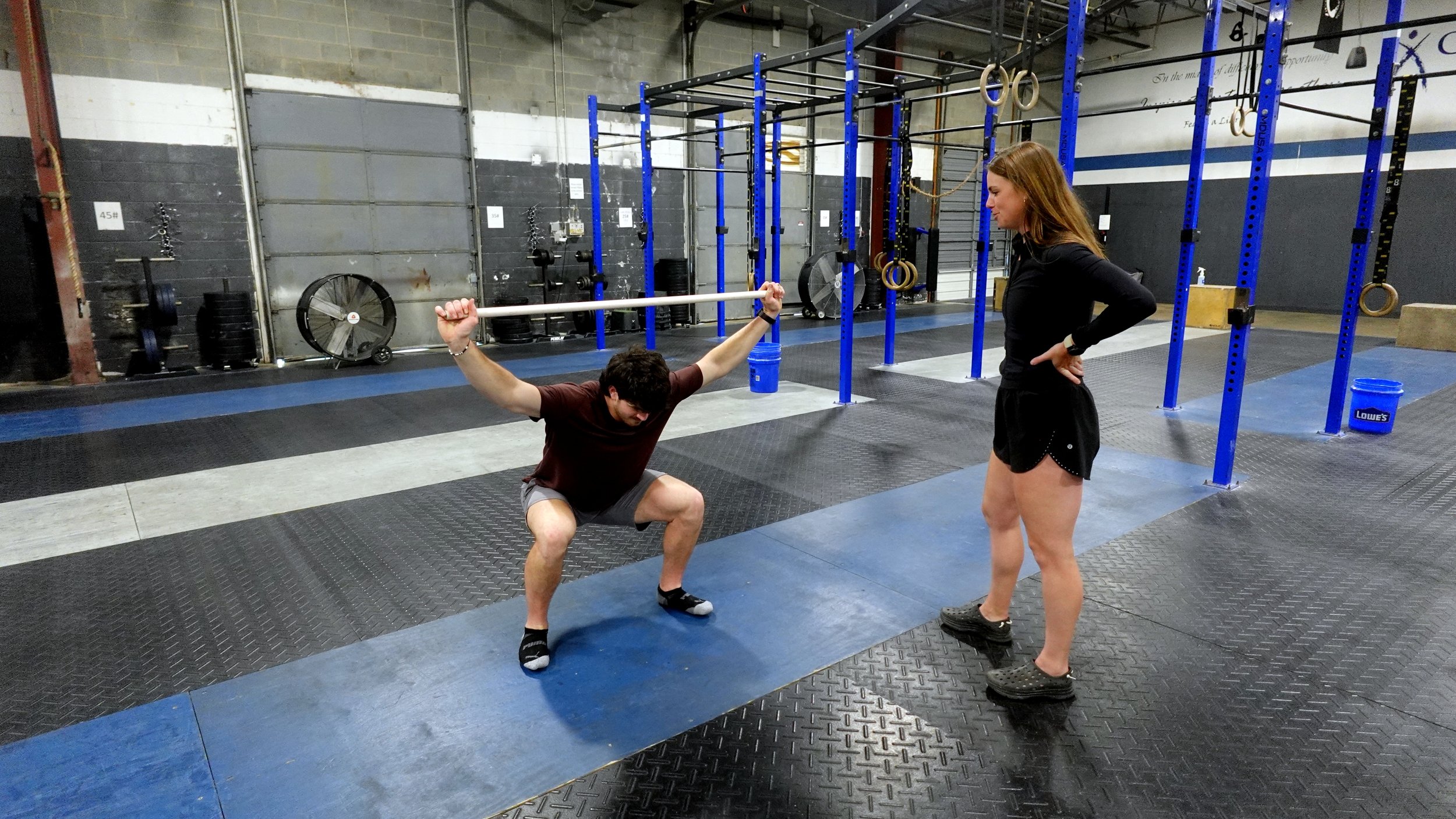
I test internal and external rotation in both the hip flexed and hip extended positions because restriction in one position does not always predict restriction in the other. I look at hip flexion range and the quality of movement through that range. I also look at how well the athlete can dissociate their pelvis from their lumbar spine, which is the foundation of any rotational sport.
What I find most often is that golfers have adequate passive range of motion, meaning they can be moved into a position, but they lack the active control to get there on their own under the demands of a dynamic movement like a golf swing. That distinction matters because stretching alone will not fix an active control problem.
The Performance Payoff
When a golfer genuinely improves their hip mobility the changes show up fast and they show up in the right places. More rotation through the backswing without compensating with the lower back. Better hip clearing through impact which translates directly to more clubhead speed. A more consistent swing pattern because the body is no longer working around restrictions on every shot.
This is not a magic fix. Building real mobility takes time and consistency. But the return on investment for a golfer is as high as almost any physical quality you could work on. More range means more power, more consistency, and significantly less stress on the structures that tend to break down over a long golf season.
The Injury Side of the Equation
Performance is one side of this conversation. Injury risk is the other.
When your hips are restricted and your body is compensating on every single swing, those compensations accumulate. The lower back takes on rotation it was never designed to handle repeatedly. The lead knee gets loaded in ways that stress the medial structures over time. The trail hip itself can develop impingement symptoms from being forced into positions it cannot access cleanly.
Low back pain is the most common injury in golfers and restricted hip mobility is one of the most consistent underlying drivers of it. If you have ever finished a round and felt your lower back seize up, or woken up the morning after 18 holes barely able to get out of bed, there is a reasonable chance your hips are part of that story.
Improving hip mobility does not just help you swing better. It distributes load more evenly across your body, reduces the cumulative stress on structures that are not built to be primary movers, and keeps you playing longer without breaking down.
Where to Start
If you are a golfer in the Charlotte area who has been dealing with swing limitations, hip tightness, or low back pain that shows up after a round, a movement assessment is the right starting point! A look at what your body is actually capable of and where the restrictions are that are holding your game back.
Ready to get started?