Knee Clicking and Popping: What It Actually Means and When to Worry
If your knees make noise every time you squat, walk down stairs, or get up from a chair, you are not alone. Knee clicking, popping, and snapping is one of the most common things athletes ask me about. And the question is almost always the same: should I be worried about this?
The honest answer is that it depends entirely on one thing. Is there pain with it or not?
That single factor changes everything about what is likely going on and what, if anything, you need to do about it.
Why Knees Make Noise in the First Place
Before we get into the pain versus no pain distinction, it helps to understand why knees make noise at all. There are a few different mechanisms behind it and they are not all created equal.
Gas bubbles in the joint fluid are one of the most common culprits. Your knee joint is surrounded by synovial fluid that lubricates the joint and reduces friction. That fluid contains dissolved gases, and when the joint moves through certain ranges, pressure changes can cause those gas bubbles to collapse or shift rapidly, creating an audible pop. This is the same mechanism behind knuckle cracking. It is harmless, it is painless, and no, it does not cause arthritis. That myth has been thoroughly debunked.
Tendons and ligaments snapping over bony prominences is another common source. As your knee moves, the soft tissue structures around it shift position. Sometimes a tendon or ligament slides over a bony landmark and snaps back into place, creating a clicking or snapping sensation. This is especially common around the outside of the knee where the IT band runs, and on the inside where the pes anserine tendons cross. Again, when this happens without pain it is usually benign.
Cartilage changes including early degeneration or surface irregularities can also create noise. As we age or accumulate training volume, the cartilage surfaces of the knee can develop slight irregularities. When those surfaces move against each other they can produce grinding, crunching, or clicking sounds. This one is worth paying a little more attention to, especially if the sound has changed over time or recently appeared alongside other symptoms.
Meniscus tears in some cases can also produce clicking or catching sensations, particularly if a flap of torn tissue is getting intermittently caught in the joint. This type of mechanical symptom is more significant and warrants evaluation.
No Pain, No Problem?
For the most part, yes. Knee noise without pain is extremely common and in the vast majority of cases is not a sign of anything serious. Research supports this. Crepitus, which is the clinical term for joint noise, is present in a huge percentage of the active population and does not reliably predict injury, arthritis progression, or future pain.
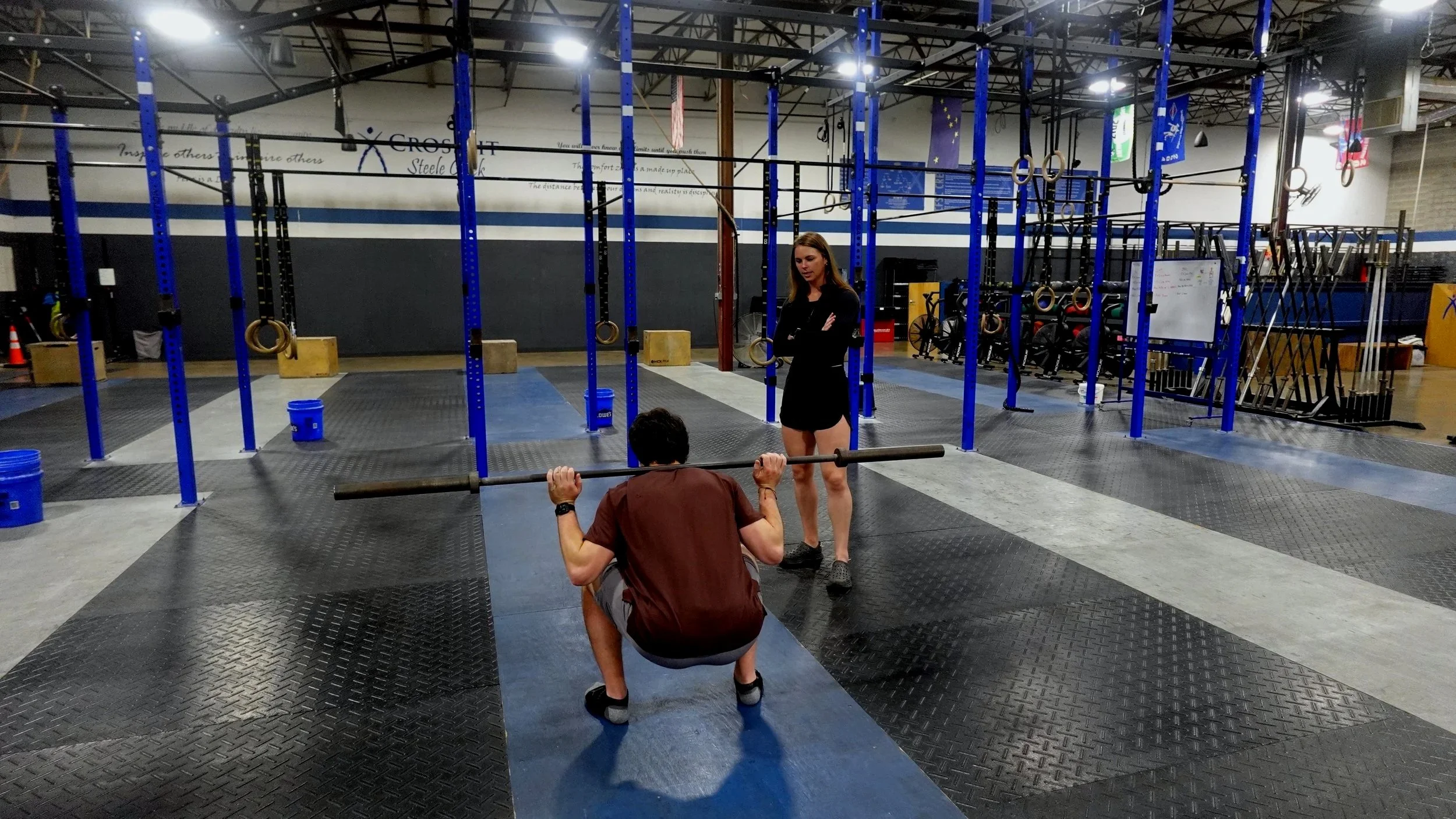
If your knees have always clicked during squats and you feel completely fine, there is no functional limitation, no swelling, no instability, and no pain, there is usually no reason to panic or change your training. Your body is just making noise. Plenty of elite athletes have noisy knees.
That said, if the character of the sound changes, if it gets louder, more frequent, or starts happening in ranges it never used to, that is worth paying attention to even before pain shows up.
When the Noise Comes With Pain
This is where the conversation changes.
Clicking or popping that is accompanied by pain is your body communicating that something is being loaded or stressed in a way it is not happy about. Pain changes the clinical picture entirely and warrants a proper evaluation rather than a wait and see approach.
Also important to note, new pop followed by immediate pain and swelling is a completely different situation. If you were doing something, heard or felt a significant pop, and then had rapid swelling and instability, that is a potential structural injury that needs to be evaluated promptly. Do not train through this.
Locking or catching where the knee actually gets stuck momentarily and will not fully extend is another red flag. This mechanical symptom suggests something is getting caught in the joint and needs to be assessed.
What a Proper Evaluation Actually Looks For
When an athlete comes in with knee noise, with or without pain, I am not just listening to the sound. I am watching how the knee loads.
Does the kneecap track well during a squat? Is there a hip strength deficit driving the knee into valgus on every rep? Is there a mobility restriction at the ankle or hip that is forcing the knee to compensate? Is the noise coming from the front, back, inside, or outside of the joint and does that location change with different movements?
The sound is a clue. The movement assessment tells me what is actually happening. In most cases of painful knee noise, there is an underlying mechanical driver that is very fixable with targeted strength work, movement pattern correction, and sometimes hands on treatment. In some cases, imaging is warranted to rule out structural pathology. But that decision is made based on the full clinical picture, not just the presence of noise.
The Bottom Line
Noisy knees are not automatically broken knees. If your knees click and pain follows, that is worth getting looked at sooner rather than later because the earlier you address it the faster and easier the fix tends to be.
If you are dealing with knee pain or noise that has been limiting your training in the Charlotte area, book your initial evaluation today and let’s figure out what’s actually going on.