
You bent over to pick up a kettlebell, a car seat, or the laundry basket, and your low back grabbed. Maybe it was a sharp catch. Maybe it was a slow ache that built over the day until standing up from your desk felt like a project.
Maybe you rested for a week. Maybe you used heat, took ibuprofen, and tried a stretching video. It eased. Then the next time you trained hard, or sat in the car for two hours, it came right back.
Rest is a pause, not a plan.
If you are searching for physical therapy for lower back pain in Charlotte, you probably have three questions. Do I need a referral or an MRI first? What actually happens when I go? And how long is this going to take? Let me answer all three honestly.
Do You Need a Referral or an MRI First?
Referral: no. In North Carolina you can see a physical therapist directly, without a referral from a doctor. Monarch is out-of-network, so there is no insurance referral rule to work around either. You call, we talk, and you come in.
MRI: usually not first. This surprises a lot of people, but spine findings are incredibly common in people who have no pain at all. In a review of more than 3,000 people with no back pain, disc degeneration showed up in 37 percent of 20-year-olds and 96 percent of 80-year-olds. Disc bulges went from 30 percent to 84 percent across the same ages.
An MRI shows what your spine looks like. It does not show why it hurts. I wrote more about this in why your MRI results do not tell the whole story, and about the scariest word on those reports in degenerative disc disease: what your doctor did not tell you.
There are times when imaging and a doctor come first. Go to urgent care or the ER today, not to me, if your back pain comes with any of these:
Loss of bladder or bowel control, or trouble starting to pee
Numbness in your groin or inner thighs
Leg weakness that is getting worse
Fever or weight loss you cannot explain
A history of cancer
A hard fall, a car crash, or another big trauma
What Happens at Your First Visit
Every visit at Monarch is a full hour, one-on-one, with me. The first one is mostly me learning how your back behaves and how you live in it.
Your story. When it started, what you lift and train, how you sit and work, what makes it better or worse, and what you already tried.
How you move. Bending, squatting, a hip hinge, and single-leg control. I want to see you do the thing that hurts, because that is where the information is.
Strength and capacity. Your back rarely works alone. Weak or stiff hips often push extra load into the low back.
A nerve screen. If you have pain, tingling, or numbness down your leg, I check how the nerves are doing.
Your training week. Load, sleep, and stress all change how much your back can handle.
You leave with what I think is going on, what to do this week, and how to keep training around it. That is the start of the Monarch Method: Assess, Restore, Rebuild, Perform.
What Treatment Actually Looks Like
Exercise is the core of it. The US physical therapy guideline for low back pain gives exercise a Grade A recommendation for chronic low back pain, with trunk strength and endurance work. The American College of Physicians also recommends treatment without medication first for new back pain.
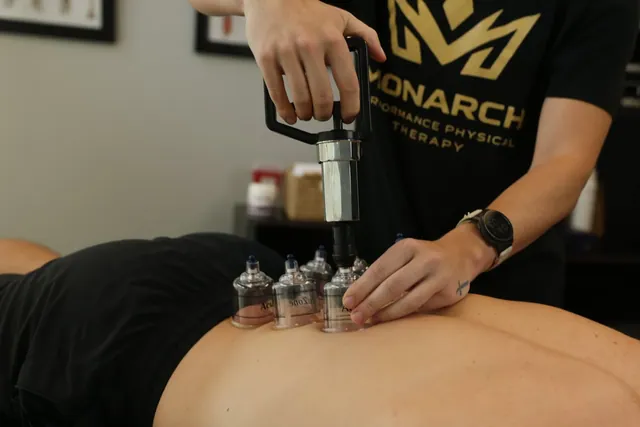
Restore. First we calm it down. That means changing your load, not stopping everything. Hands-on work or dry needling can help you move with less pain while we do that. They support the exercise, but they do not replace it.
Rebuild. Then we load it. Progressive strength for your hips, your trunk, and your back itself, until the hinge and the squat feel normal again. If you lift, this is where we get you back under the bar. My post on low back pain after deadlifts shows what that looks like.
Perform. Back to your sport or your heaviest lifts, based on criteria you meet, not a date on the calendar.
Think of your back like a bridge rated for a certain load. Pain usually means the traffic got heavier than the rating. You can close the bridge for a while, but the rating does not change. We raise the rating.
What Won't Fix It
Bed rest. It makes most back pain last longer, not shorter.
Waiting for an MRI to tell you what to do. See the numbers above.
A generic core program. Planks are fine. They are not a plan for your back.
Only passive care. Massage, heat, and adjustments can feel great. If your capacity does not change, the pain comes back.
Being scared to move. Fear of movement is one of the things that makes back pain stick around. Your back is strong. Right now it is irritated.
How Long Does Physical Therapy Take for Back Pain?
Here is the honest answer, with real numbers.
Most new back pain gets a lot better in about six weeks. In a 2024 review of 95 studies, average pain in people with new low back pain dropped from a pain score of 56 out of 100 to 26 out of 100 by six weeks.
But better is not the same as gone. In that same review, average pain was still about 21 out of 100 a year later.
Pain that has lasted past three months moves slower. In that group, average pain went from 56 to about 40 at one year. If that is you, a real plan matters most.
Timing matters. In a study of more than 32,000 people with a new back pain visit, those who saw a physical therapist within 14 days were less likely to end up with advanced imaging, injections, surgery, or opioids than those who waited.
And here is the part most clinics will not tell you. If your back pain is three days old and getting better every day, you may not need me yet. A trial of early physical therapy for brand new back pain found only a small benefit over usual care. If it keeps coming back, or it has hung around for more than a few weeks, that is when I want to see you.
I will not give you a number of visits before I have assessed you. After the first visit, I will tell you where I think you are and what the plan looks like.
The Bottom Line
Most back pain is not dangerous, and most of it gets better. The back pain that keeps coming back is usually a capacity problem, and capacity is trainable.
If you are in Charlotte, Steele Creek, Ballantyne, South Charlotte, Pineville, or Fort Mill and your back flares up every time you train, sit, or pick something up, you do not have to keep guessing. Learn more about back pain physical therapy in Charlotte, or book a free 15-minute phone call today and let's figure out exactly what is going on.
Thanks for reading!
-Dr. Kiley
This article is for education only. It is not medical advice, and it does not diagnose your back pain. If you have any of the warning signs above, see a doctor right away.