What Ballantyne Runners Should Know Before Choosing a PT
If you're a runner in the Ballantyne area, you already know the drill. You push through a nagging pain for a few weeks, it doesn't go away, and you finally decide to do something about it.
You end up at a PT clinic where you spend 10 minutes with an actual therapist and 40 minutes doing exercises with a tech or assistant who's also watching two other patients at the same time.
You leave with a sheet of band exercises, told to ice it and rest. A few weeks later you're back to square one.
That level of care is not going to get you back running a new PR at your next race.
What Ballantyne Runners Actually Deal With
Running is repetitive by nature, which means the injuries that come with it tend to build slowly and hit hard. The most common things I see in runners from the Ballantyne corridor:
IT band syndrome that doesn't respond to stretching (because stretching isn't the fix)
Plantar fasciitis that's been "resting" for months and keeps coming back
Knee pain that shows up at mile 4 and ruins every long run
Achilles tendinopathy that eccentric heel drops aren’t curing anymore
Hip and glute weakness masquerading as a foot or knee problem
What these injuries all have in common is that they're rarely about the place that hurts.
IT band pain isn't an IT band problem.
Plantar fasciitis usually isn't just a foot problem.
The symptom and the source are almost never the same thing and if your PT is only treating where it hurts, you're going to keep ending up back in their office.
What Good Running PT Actually Looks Like
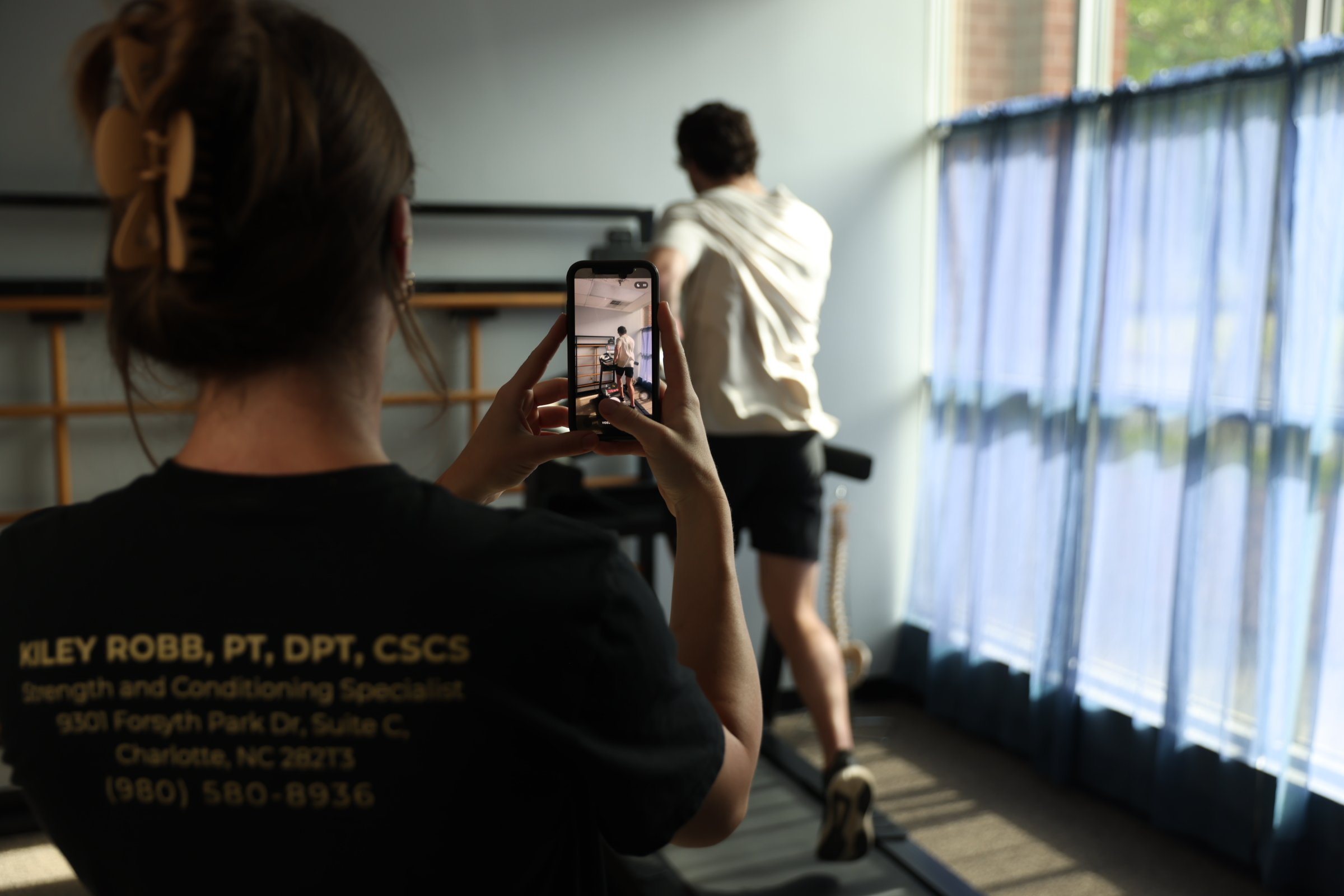
A thorough running injury evaluation should include a full movement screen, a look at your running mechanics, and an honest assessment of your training load. Not just "where does it hurt and when did it start."
Treatment should be hands-on; manual therapy, dry needling if appropriate, soft tissue work, combined with a progressive strength program that targets the actual root cause.
And it should be done by the same person every single session, someone who knows your history, tracks your progress, and adjusts your plan week to week based on how you're responding.
Rehab should also progress into actual running.
Not just treadmill walking. Not just bodyweight exercises.
Real return-to-run progressions with clear benchmarks.
Why Most Clinics in the Area Fall Short
The majority of PT clinics operating in and around Ballantyne are insurance-based, which means they're built around volume. High patient loads, short sessions, and a model that incentivizes quantity over quality. That's not a knock on the therapists; it's a structural problem with how those businesses have to operate to survive.
When your therapist is seeing 12-15 patients a day, there is simply not enough time to do the kind of thorough, individualized work that running injuries require.
What We Do Differently at Monarch Performance PT
Monarch Physical Therapy is a one-on-one, cash-based sports physical therapy clinic serving runners and athletes throughout the Ballantyne area.
Every session is 60 minutes with me, Dr. Kiley Robb, PT, DPT, CSCS, start to finish. No aides, no handoffs, no recycled programs.
I'm a Doctor of Physical Therapy, a Certified Strength and Conditioning Specialist, and an active runner and endurance athlete myself. I've trained under elite sports PT programs and rehabbed athletes at the professional level.
I know what it takes to get back to running, and not just because of the letters behind my name, but because I have actually been there.
If you're a Ballantyne runner dealing with an injury that isn't getting better, or one that keeps coming back, it's time to talk to someone who gets it.
Book a running evaluation today!
-Dr. Kiley